
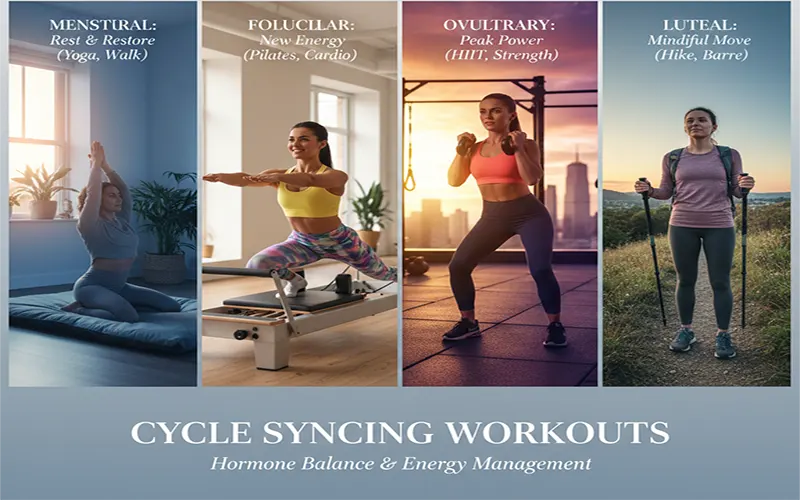
In the fitness world, the standard advice is almost always built on a 24-hour linear model: wake up, push hard, recover, and repeat. While this works for the male hormonal profile, women operate on a second biological clock known as the Infradian Rhythm. This 28-day cycle governs everything from metabolism and brain chemistry to immune function and stress response.
When women ignore this rhythm and attempt to maintain high-intensity training every single day, they often face a “hormonal tax.” This manifests as burnout, stubborn weight gain, disrupted sleep, and worsening PMS. Cycle syncing is the practice of aligning your exercise intensity and type with your hormonal shifts, allowing you to work with your biology rather than against it.
The Foundation: Understanding the Infradian Rhythm
Most fitness research is conducted on men because their hormonal profile is relatively stable over 24 hours. Women, however, experience significant fluctuations in Estrogen, Progesterone, and Testosterone over roughly 28 days.
Attempting a grueling HIIT session when your hormones are at their lowest (the Menstrual phase) can spike cortisol levels excessively. Conversely, skipping a heavy lifting session when your estrogen is peaking (the Ovulatory phase) means missing your greatest window for strength gains. Cycle syncing isn’t about doing “less”; it’s about doing the right thing at the right time.
Phase 1: The Menstrual Phase (The Winter)
Days 1–5 (approx.)
At the start of your cycle, estrogen and progesterone are at their lowest. Your body is undergoing an energy-intensive process of shedding the uterine lining.
- The Energy State: Lowered physical stamina and a naturally higher need for rest.
- The Workout Strategy: Restorative and Low-Impact. This is the time for yin yoga, leisurely walking, or complete rest. Movement should focus on lymphatic drainage and pelvic blood flow.
- The Science: High-intensity exercise during this phase can trigger a significant inflammatory response. By slowing down, you allow your body to reset, preventing the “mid-month burnout” that many women experience.
- Fueling: Focus on iron-rich foods (red meat, spinach, lentils) and anti-inflammatory fats to support blood loss and cramps.
Phase 2: The Follicular Phase (The Spring)
Days 6–12 (approx.)
As your period ends, the Follicular Stimulating Hormone (FSH) rises, prompting estrogen to climb. This is the “get things done” phase.
- The Energy State: Rising energy, increased mental clarity, and a renewed sense of motivation.
- The Workout Strategy: Strength Training and Skill Building. Your body is primed for neuroplasticity. This is the perfect time to try a new workout class or focus on complex movements like Olympic lifting or dance.
- The Science: Estrogen is anabolic (muscle-building). During this window, you have a higher pain tolerance and a faster recovery time. You can handle more volume and intensity as you climb toward ovulation.
- Fueling: Support estrogen metabolism with sprouted and fermented foods like kimchi, sauerkraut, and cruciferous vegetables.
Phase 3: The Ovulatory Phase (The Summer)
Days 13–15 (approx.)
Estrogen and Testosterone peak during this brief window. This is your biological “power phase.”
- The Energy State: Peak physical performance, high libido, and social confidence.
- The Workout Strategy: HIIT, Heavy Lifting, and Power. Now is the time for your heaviest deadlifts, sprinting, or high-energy group fitness.
- The Science: Caution is required. Peak estrogen levels are linked to increased ligament laxity (looseness). You are statistically more prone to ACL injuries during ovulation. Ensure your warm-ups are thorough and your form is impeccable.
- Fueling: You may feel less hungry during this phase. Focus on light, fiber-rich meals to help the liver process the surge of hormones.
Phase 4: The Luteal Phase (The Autumn)
Days 16–28 (approx.)
Following ovulation, progesterone becomes the dominant hormone. This phase is divided into “Early Luteal” and “Late Luteal” (the PMS window).
- The Energy State: Energy begins to taper. In the late luteal phase, the body’s basal metabolic rate increases by 5–10%, and your core body temperature rises.
- The Workout Strategy: Functional Strength and Low-Impact Cardio. Shift toward Pilates, incline walking, or moderate strength training. As you approach Day 28, transition to purely restorative movement.
- The Science: Progesterone is “thermogenic” and catabolic (muscle-breaking). Your body is less efficient at using carbs for fuel and more reliant on fats. High-intensity cardio in the late luteal phase can feel twice as hard and can actually trigger the body to store fat as a protective mechanism against the “stress” of the workout.
- Fueling: You need more calories (about 200–300 extra) during this phase. Focus on complex carbohydrates (sweet potatoes, oats) to stabilize blood sugar and manage cravings.
Phase-at-a-Glance Summary Table
| Phase | Duration | Hormone Profile | Best Workout | Focus |
| Menstrual | Days 1–5 | All low | Walking, Yoga | Recovery |
| Follicular | Days 6–12 | Estrogen rising | Strength, New skills | Building |
| Ovulatory | Days 13–15 | Peak Estrogen/Test | HIIT, Heavy Weights | Power |
| Luteal | Days 16–28 | High Progesterone | Pilates, Hiking | Maintenance |
Managing Cortisol: Why “Pushing Through” Fails
When women with hormone imbalances—such as PCOS or high stress—push through the Luteal phase with “No Days Off,” they often experience cortisol “flat-lining.” Because progesterone makes you more sensitive to stress, a high-intensity workout can keep your cortisol elevated for too long. This inhibits the thyroid and disrupts the delicate ratio between estrogen and progesterone, leading to heavier periods, mood swings, and “tired but wired” nights. Cycle syncing isn’t “lazy”; it is a strategic management of your nervous system.
Practical Application: How to Start
If you aren’t used to tracking your cycle, start by using an app or a simple calendar to note Day 1 (the first day of your period).
- Week 1: Do 2–3 days of gentle movement; sleep more.
- Week 2: Hit the gym for 4–5 days; focus on progressive overload.
- Week 3: Go for your “Personal Bests” (PBs) early in the week; watch your form.
- Week 4: Scale back to 3 days of moderate movement; prioritize walks and stretching.
Cycle syncing is a journey toward body literacy. By honoring the Infradian Rhythm, you move away from the “punishment” model of fitness and into a “partnership” model with your body. When you stop fighting your hormones, you’ll find that your energy stabilizes, your recovery improves, and your results—both physical and mental—become sustainable for the long term.