In the pursuit of “glass skin” or the aggressive management of acne and aging, we often treat our skin as a surface to be scrubbed rather than a living ecosystem. In 2026, clinical dermatology has moved toward Corneotherapy—the science of defending the stratum corneum (the skin barrier) to ensure the health of the deeper layers.
When your skin feels tight, stings upon product application, or exhibits persistent redness and “rough” texture, you aren’t just dealing with dry skin. You are likely experiencing Dysbiosis: an ecosystem collapse where your skin’s protective microbiome has been stripped away, allowing opportunistic pathogens to trigger chronic inflammation.
The Biological Shield: Stratum Corneum & The Microbiome
The skin barrier is composed of two primary components:
- The Physical Barrier: The “bricks and mortar” (dead skin cells held together by lipids).
- The Living Barrier: The Microbiome, a diverse community of bacteria, fungi, and mites that live in the acid mantle.
When the microbiome is healthy, it produces antimicrobial peptides and maintains an acidic pH (around 4.7–5.5). This acidity is vital; it keeps the “bad” bacteria like Staph aureus in check and activates the enzymes that build the physical barrier. When you over-exfoliate, you destroy this acidic habitat, leading to a “leaky” skin barrier.
Phase 0: The “Stop the Bleeding” Protocol
Before starting a repair routine, you must remove the aggressors. For the next 14 to 28 days (one full skin cell cycle), you must pause:
- All Retinoids (Tretinoin, Retinol, Adapalene).
- All Direct Acids (AHAs, BHAs, Vitamin C/L-Ascorbic Acid).
- Physical Scrubs and Cleansing Brushes.
- Fragrances and Essential Oils.
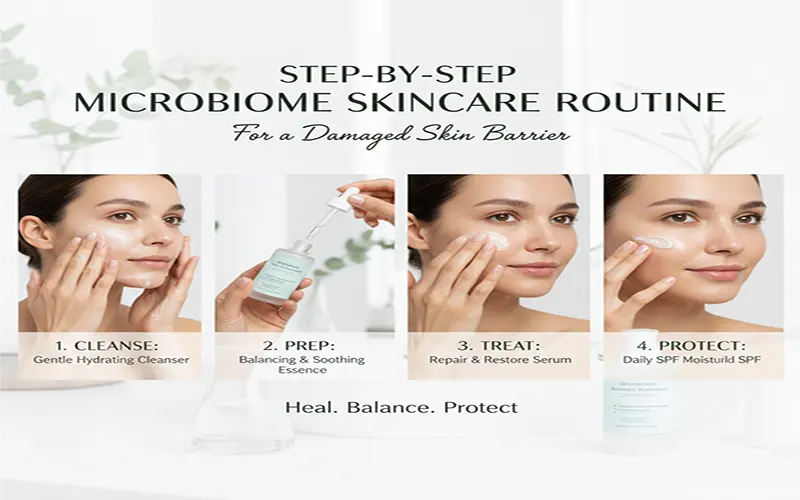
The Step-by-Step Microbiome Repair Routine
This routine focuses on Low-Stimulus restoration, feeding the beneficial bacteria while physically patching the lipid gaps.
Step 1: Non-Stripping, pH-Balanced Cleansing
Most damage starts at the sink. If your cleanser leaves your face feeling “squeaky clean,” it is too alkaline and is stripping your acid mantle.
- The Goal: Remove debris without disrupting the resident microbes.
- The Method: Use a creamy, non-foaming cleanser or a milk cleanser. Look for “surfactant-free” formulas.
- Pro-Tip: Wash with lukewarm water only. Hot water melts away the very lipids (ceramides) your skin is desperately trying to produce.
Step 2: Prebiotic Hydration (Feeding the “Good Guys”)
Once clean, your skin needs a “primer” that signals safety to your immune system.
- The Goal: Provide food for the beneficial bacteria like S. epidermidis.
- The Ingredient: Prebiotics (like Inulin, Alpha-glucan oligosaccharide, or Thermal Spring Water).
- The Method: Mist your face with a prebiotic-rich thermal water or press in a milky essence containing fermented extracts. This re-acidifies the skin surface instantly.
Step 3: Probiotic and Postbiotic Repair
This is the “communication” step.
- The Goal: Use “biologics” to calm the inflammatory response.
- The Ingredients: Look for Bifida Ferment Lysate or Lactobacillus Ferment. These are “postbiotics”—non-living bacterial components that trick the skin into thinking it has a robust defense, which triggers a healing response.
- The Method: Apply a concentrated repair serum. This step tells the skin’s immune system to stop the “redness” alarm.
Step 4: Lipid Replacement (The 3:1:1 Ratio)
Moisturizing is not enough; you need bio-identical repair.
- The Goal: Mimic the skin’s natural lipid structure.
- The Science: Research shows that the skin barrier repairs fastest when provided with a specific ratio of 3:1:1 (Ceramides, Cholesterol, and Fatty Acids).
- The Method: Use a barrier cream that explicitly mentions this ratio or contains “lamellar” technology, which mimics the structure of skin cells.
Key Ingredients: The Barrier Toolkit
To navigate the aisles in 2026, look for these specific “ecosystem-friendly” ingredients:
- Squalane: A stable, plant-derived version of the squalene found in our own sebum. It provides weightless occlusion.
- Beta-Glucan: Derived from oats or mushrooms, it is 20% more hydrating than hyaluronic acid and deeply soothing.
- Colloidal Oatmeal: A classic for a reason; it contains avenanthramides that specifically block the “itch” and “sting” receptors in the skin.
- Panthenol (Pro-Vitamin B5): Acts as a humectant that also promotes wound healing.
Biotics Defined: A Comparison for Clarity
Understanding the “Biotic” labels is essential for microbiome health.
| Term | What It Is | Role in Skin Repair |
| Prebiotics | Non-digestible plant sugars (Inulin). | “Food” for the good bacteria you already have. |
| Probiotics | Live beneficial bacteria. | Rarely found in shelf-stable skincare; mostly in “live” oils. |
| Postbiotics | Bacterial ferments or lysates (dead bacteria). | Signals the skin to reduce inflammation and heal. |
The Timeline: What to Expect
Healing a barrier is a marathon, not a sprint.
- Days 1–3: Stinging should subside. Skin may still look red but will feel less “tight.”
- Week 1: Texture begins to smooth out. The “crepey” look of dehydration diminishes.
- Week 2–4: The microbiome begins to stabilize. The skin pH returns to its acidic sweet spot, and you may notice fewer “random” breakouts.
- Month 2: The stratum corneum is fully reinforced. You can slowly (once a week) reintroduce a gentle active like Azelaic Acid or a low-percentage Lactic Acid.
The Gut-Skin Axis: Internal Support
Microbiome health isn’t just topical. High-fiber diets and oral probiotics (specifically Lactobacillus rhamnosus GG) have been clinically shown to reduce systemic inflammation, which in turn reduces “inflammaging” and redness on the face. Drink plenty of water and prioritize sleep, as the skin’s repair mechanisms peak during the circadian night cycle.
Final Verdict
Repairing a damaged skin barrier requires a shift in mindset: you are no longer a “user” of skincare, but a “steward” of an ecosystem. By simplifying your routine and focusing on pH-balanced, lipid-rich, and biotic-friendly formulas, you allow your skin to do what it does best—protect you.