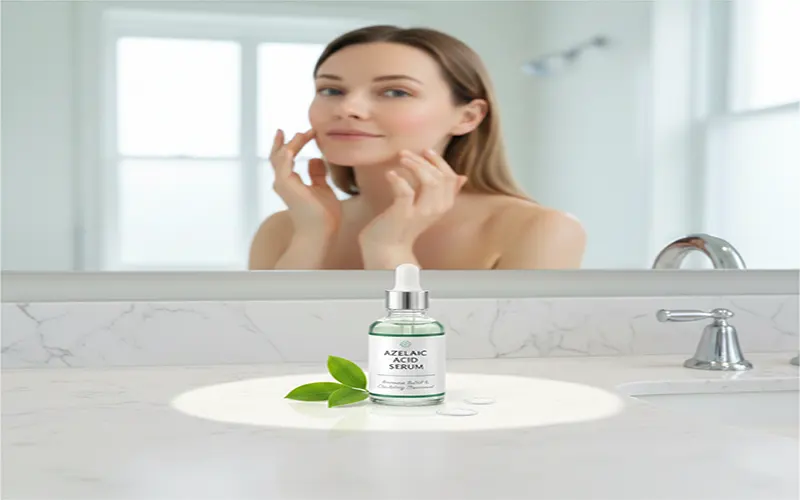
In the world of dermatology, few ingredients are as versatile—yet as underrated—as Azelaic Acid. While Retinol and Vitamin C often hog the spotlight, Azelaic Acid is the “quiet overachiever” that manages to address two of the most frustrating skin concerns simultaneously: Rosacea and Hormonal Acne.
For women in their 30s, 40s, and beyond, these two conditions often collide. You may find yourself dealing with the persistent redness and broken capillaries of rosacea alongside the deep, painful cystic breakouts of a hormonal shift. Azelaic Acid is one of the few ingredients that can treat both without the irritation associated with harsher acids.
What is Azelaic Acid?
Azelaic Acid is a naturally occurring dicarboxylic acid found in grains like barley, wheat, and rye. In skincare, it is typically bio-engineered for stability. Unlike Alpha Hydroxy Acids (AHAs) or Beta Hydroxy Acids (BHAs), Azelaic Acid has a larger molecular structure.
This larger size means it penetrates the skin more slowly and stays closer to the surface, which is why it is famously well-tolerated by those with sensitive or reactive skin barriers.
Part 1: The Solution for Rosacea
If you struggle with Type 2 (Papulopustular) Rosacea, you know that your skin is in a constant state of “high alert.” Your immune system is overreacting to external triggers, causing persistent redness and small, acne-like bumps.
Inhibiting Cathelicidins
The primary reason Azelaic Acid is a gold-standard treatment for rosacea is its ability to inhibit cathelicidins. These are pro-inflammatory peptides that are found in much higher concentrations in rosacea-prone skin. By dialing down these peptides, Azelaic Acid tells your skin’s immune system to “stand down,” leading to a visible reduction in flushing and swelling.
Vascular Calming
While it cannot “erase” a broken capillary that has already formed, Azelaic Acid prevents the inflammatory cascades that lead to new ones. It acts as an antioxidant, neutralizing the free radicals that contribute to the chronic redness associated with the condition.
Part 2: The Solution for Hormonal Acne
Hormonal acne typically appears on the lower third of the face—the jawline and chin. These breakouts are often inflammatory and leave behind stubborn red or purple marks.
Antimicrobial and Comedolytic Properties
Azelaic Acid works in two ways here:
- Bactericidal: It kills C. acnes (the bacteria responsible for breakouts) without the risk of antibiotic resistance.
- Keratolytic: It normalizes the way your skin sheds dead cells, preventing the “sticky” cells from clogging pores in the first place.
The “Eraser” of Post-Inflammatory Hyperpigmentation (PIH)
One of Azelaic Acid’s most famous “side effects” is its ability to inhibit tyrosinase, the enzyme responsible for melanin production. This makes it incredibly effective at fading the dark spots left behind by hormonal cysts. It is “smart” in its approach; it only targets overactive melanocytes (the dark spots) without bleaching your normal skin tone.
Concentration: OTC vs. Prescription
In 2026, the market for Azelaic Acid has expanded significantly, but the concentration you choose dictates the results you’ll see.
- 10% (Over-the-Counter): Excellent for maintenance and mild redness. These are often found in “suspension” formulas (like The Ordinary) or combined with soothing agents like Niacinamide (like Paula’s Choice).
- 15% (Prescription Gel): Usually sold as Finacea. This is the clinical sweet spot for Rosacea. The gel formulation allows for better penetration than a thick cream.
- 20% (Prescription Cream): Usually sold as Azelex. This higher concentration is typically used for more severe acne and melasma.
How to Use: The Protocol
Azelaic Acid is most effective when used consistently, typically once or twice a day.
The Step-by-Step Routine
- Cleanse: Use a gentle, non-stripping cleanser.
- Apply Azelaic Acid: Apply a pea-sized amount to the entire face (it is a preventative treatment, not just a spot treatment).
- Moisturize: Follow with a barrier-repairing cream.
- Protect (AM): Always use SPF, as UV rays are the #1 trigger for both rosacea and acne scarring.
The “Sandwich Method” for Sensitive Skin
If you find the acid causes a “prickly” or “itchy” sensation, apply a thin layer of moisturizer first, then the Azelaic Acid, then another layer of moisturizer. This buffers the absorption without negating the benefits.
Synergy: What to Pair (and What to Avoid)
Azelaic Acid plays remarkably well with other ingredients, but there are a few rules to follow.
| Pair With | Why? |
| Niacinamide | Enhances the anti-redness effect and supports the barrier. |
| Hyaluronic Acid | Offsets any mild dryness caused by the acid. |
| Retinoids | Can be used together (AA in AM, Retinoid in PM) for advanced anti-aging and acne control. |
Avoid: Using strong Glycolic or Salicylic acid peels in the same window as your Azelaic Acid, as this can over-exfoliate the skin and trigger a rosacea flare.
Managing Expectations: The “Tingle” and The Timeline
When you first start using Azelaic Acid, it is common to feel a “crawling” or “itchy” sensation for the first 15–20 minutes after application. This is not an allergic reaction; it is a common sensory response to the low pH of the acid. This usually subsides after 2 weeks of consistent use.
- Redness Reduction: 4–6 weeks.
- Acne Improvement: 6–8 weeks.
- Fading Dark Spots: 12+ weeks.
Azelaic Acid is a rare skincare unicorn. It is powerful enough to tackle clinical conditions like rosacea and cystic acne, yet gentle enough to be used by those with the most sensitive skin. By regulating cellular communication and calming the skin’s inflammatory response, it doesn’t just treat the symptoms—it helps restore the skin to a state of balance.
Whether you are dealing with the “maskne” of today or the hormonal shifts of tomorrow, making Azelaic Acid a cornerstone of your routine is one of the smartest moves you can make for long-term skin health.